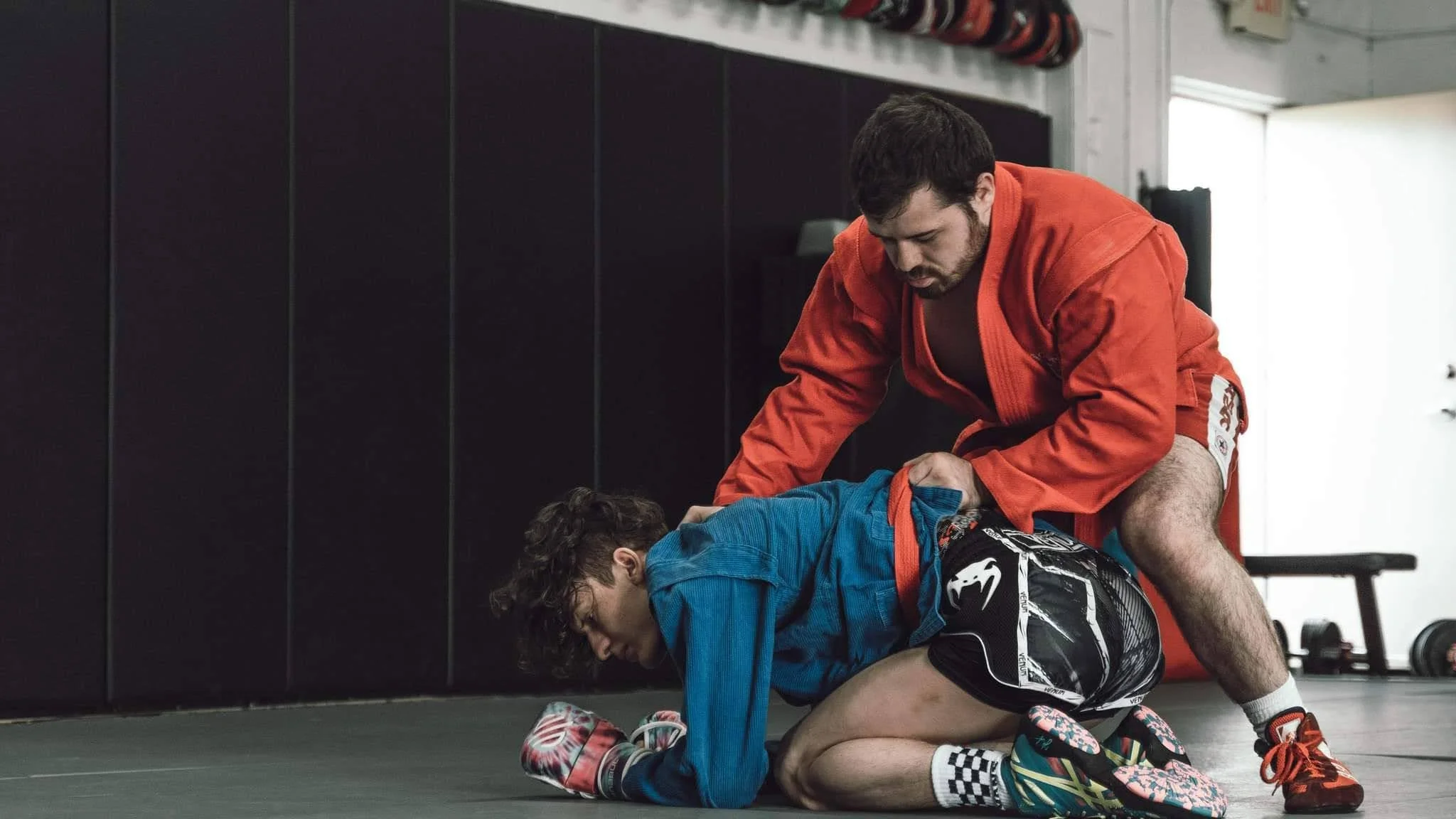
Combat Sambo is one of the world’s most complete fighting systems — and there is exactly one gym in Michigan teaching it under a qualified instructor. This is the full breakdown: where Sambo came from, how it differs from BJJ and MMA, who should train it, and how to get on the mat.
What Is Combat Sambo?
Combat Sambo is a complete fighting system developed by the Soviet Red Army in the 1920s for military hand-to-hand combat training. The name comes from a Russian acronym — SAMozashchita Bez Oruzhiya — which translates to “self-defense without weapons.”
Unlike sport-restricted disciplines that specialize in one range of combat, Combat Sambo integrates striking, wrestling, throws, takedowns, and submissions into a single, cohesive system. Standing, clinch, ground — every range is addressed. Punches, elbows, kicks, knees — all permitted. Throws, leg locks, chokes, joint locks — all in play.
Over decades, Combat Sambo evolved from a military training method into both a competitive sport and one of the most effective civilian self-defense systems in existence. It’s been adopted by special forces and military units in dozens of countries — and has produced some of the most technically complete MMA fighters in the modern era, most notably Khabib Nurmagomedov and Fedor Emelianenko.
Victorious MMA in Troy, Michigan is the only gym in the state offering authentic Combat Sambo instruction. Professor Victor “El Torito” Torres teaches Combat Sambo every Saturday at 11 AM.
How Combat Sambo Differs from Other Martial Arts
Most martial artists training in Michigan have a base in BJJ, Muay Thai, wrestling, or judo. Each of those is a deep, technically rich discipline — and each one specializes in a slice of combat. Combat Sambo is different: it’s the system that integrates all of them.
Combat Sambo vs. Brazilian Jiu-Jitsu
BJJ is built around ground submissions. The art has produced the deepest, most sophisticated catalog of guards, sweeps, and finishes in modern grappling. But by rule and by training culture, BJJ excludes striking. Roll on a BJJ mat and there is no concept of getting hit — which means there’s no need to account for punches, elbows, or knees in your positional choices.
Combat Sambo keeps the grappling — including a deeper leg-lock catalog than most BJJ academies teach — and adds the striking back in. Every position has to account for the possibility of getting hit. Every entry, every transition, every guard is evaluated with strikes on the table.
If you train BJJ and want to bulletproof your game against the realities of full-contact combat, Combat Sambo is the bridge.
Combat Sambo vs. Muay Thai & Kickboxing
Muay Thai and kickboxing develop elite striking. Punches, kicks, knees, elbows, clinch work — all of it. But pure strikers face a cliff: the moment the fight goes to the ground, the system stops covering you. Wrestlers, BJJ practitioners, and Sambo players who can take strikers down expose this gap immediately.
Combat Sambo incorporates the striking discipline of Muay Thai but extends it with takedown defense, takedown offense, and a full ground game. Strikers who add Sambo become complete fighters rather than one-dimensional specialists.
Combat Sambo vs. Wrestling & Judo
Wrestlers control where the fight happens — they can force the clinch, get takedowns, and dominate position. Judoka have explosive throws and a foundation in standing grappling. Both arts are positionally devastating but rule-limited in submissions and striking.
Combat Sambo carries forward the takedowns and throws of wrestling and judo, then adds submissions (especially leg locks) and striking. A Sambo player can hit a single-leg like a wrestler, finish on top with ground-and-pound, or transition straight into an Achilles lock — all from the same takedown entry.
Why No Other Michigan Gym Teaches It
Combat Sambo is rare in the United States generally, and rarer still in the Midwest. There are three reasons.
First — qualified instructors are scarce. Combat Sambo requires deep training in striking, throwing, and grappling simultaneously. Most gyms specialize: a BJJ school has BJJ black belts, a Muay Thai school has Muay Thai trainers. Combat Sambo demands an instructor who is technically fluent across all of them — and there are very few of those in the country, let alone in any one state.
Second — it doesn’t fit a sport-school business model. Most martial arts gyms in the U.S. organize around competitive disciplines that have established tournament structures: BJJ has IBJJF, Muay Thai has WBC, wrestling has its school system. Combat Sambo’s competitive footprint in the U.S. is small, which means there’s less commercial incentive to build a program around it.
Third — the cultural roots are Russian. Combat Sambo’s center of gravity is still Eastern Europe. Most American martial artists don’t grow up exposed to it. Without direct exposure, demand never builds.
Victor Torres broke through these obstacles for a single reason: he studied the art seriously, and when he opened Victorious MMA in 2010, he decided to bring it home with him. Today his program at Victorious is, as far as we can verify, the only active Combat Sambo program at any commercial martial arts gym in Michigan.
Who Should Train Combat Sambo?
Combat Sambo is not a beginner’s martial art. It moves fast, every range is in play, and the technical breadth is significant. The class is best for:
- MMA competitors looking to round out their game with the striking-into-takedown sequences that Sambo specializes in.
- Experienced BJJ practitioners who want to add throws, leg locks, and the threat awareness that strikes bring to the ground game.
- Muay Thai or kickboxing practitioners ready to address the takedown vulnerability of pure stand-up training.
- Wrestlers and judoka looking for the submission and striking layer that complements their existing positional dominance.
- Self-defense oriented martial artists who want a complete system over a specialty.
If you’re brand new to martial arts, Victor will typically recommend starting with Adult BJJ or Kickboxing first to build a base — then layer Combat Sambo on top once you’re moving safely and reading positions.
Combat Sambo at Victorious MMA
The Combat Sambo program at Victorious MMA runs every Saturday at 11 AM. The class is built around the principle that the system has to be trained as a system — striking, throws, and submissions integrated in every drill rather than taught as separate modules.
The Instructor
Professor Victor “El Torito” Torres founded Victorious MMA in 2010 and has been the lead Combat Sambo instructor in Michigan ever since. His background in Combat Sambo combined with decades of BJJ and MMA coaching gives the class the technical depth it needs to be effective — and the safety standards it needs to keep practitioners healthy and progressing.
The Format
A typical Saturday class moves through:
- Warm-up and Sambo-specific movement drills
- Striking-to-takedown chain technique
- Throw or leg-lock entry of the day
- Positional sparring focused on the day’s theme
- Open rolling for those who want it
The class moves at pace. Come ready to work.
What to Bring
- BJJ gi (or no-gi gear depending on the day’s focus — call ahead if unsure)
- Mouthguard
- Optional: shin guards and headgear for striking drills
- Water and a towel
How to Get Started
Start with a free trial class. There’s no contract, no pressure, and no expectation that you’ll sign up after — if Combat Sambo isn’t the right fit, we’d rather you find that out before joining. Book a trial and come watch a class first if you’d prefer; you can decide whether to step on the mat from there.
If you’re traveling in from elsewhere in Michigan and want to drop in for a Saturday session, call ahead so we can make sure the class is running and you’ll have a partner at your experience level.
Combat Sambo at Victorious MMA — Michigan’s only authentic program. Book a free trial class to get started.
Frequently Asked Questions
Where can I train Combat Sambo in Michigan?
Victorious MMA in Troy, Michigan is the only gym in the state offering authentic Combat Sambo instruction. Professor Victor Torres teaches Combat Sambo every Saturday at 11 AM at 444 West Maple Road, Troy, MI.
What is the difference between Combat Sambo and BJJ?
BJJ focuses on ground submissions with no striking allowed. Combat Sambo adds striking, explosive throws, and leg locks that BJJ does not allow, making it a more complete system covering all ranges of combat — standing, clinch, and ground.
Do I need martial arts experience to train Combat Sambo?
Combat Sambo classes at Victorious MMA are recommended for experienced practitioners. Some martial arts background — BJJ, wrestling, judo, or striking — is recommended so you can train safely and get the most out of class. New martial artists should start with BJJ or kickboxing first.
Is Combat Sambo a sport or a self-defense system?
Combat Sambo is both. It was developed by the Soviet military as a hand-to-hand combat system, then evolved into a competitive sport. The version taught at Victorious MMA preserves the complete combat system — striking, throws, takedowns, and submissions — rather than a sport-restricted variant.
How much does Combat Sambo training cost?
Combat Sambo is included with a Victorious MMA membership. Book a free trial class to experience it before committing to membership.